A curved stone reception desk may look effortless once it is installed.
Getting it there takes careful work long before anyone arrives on site.
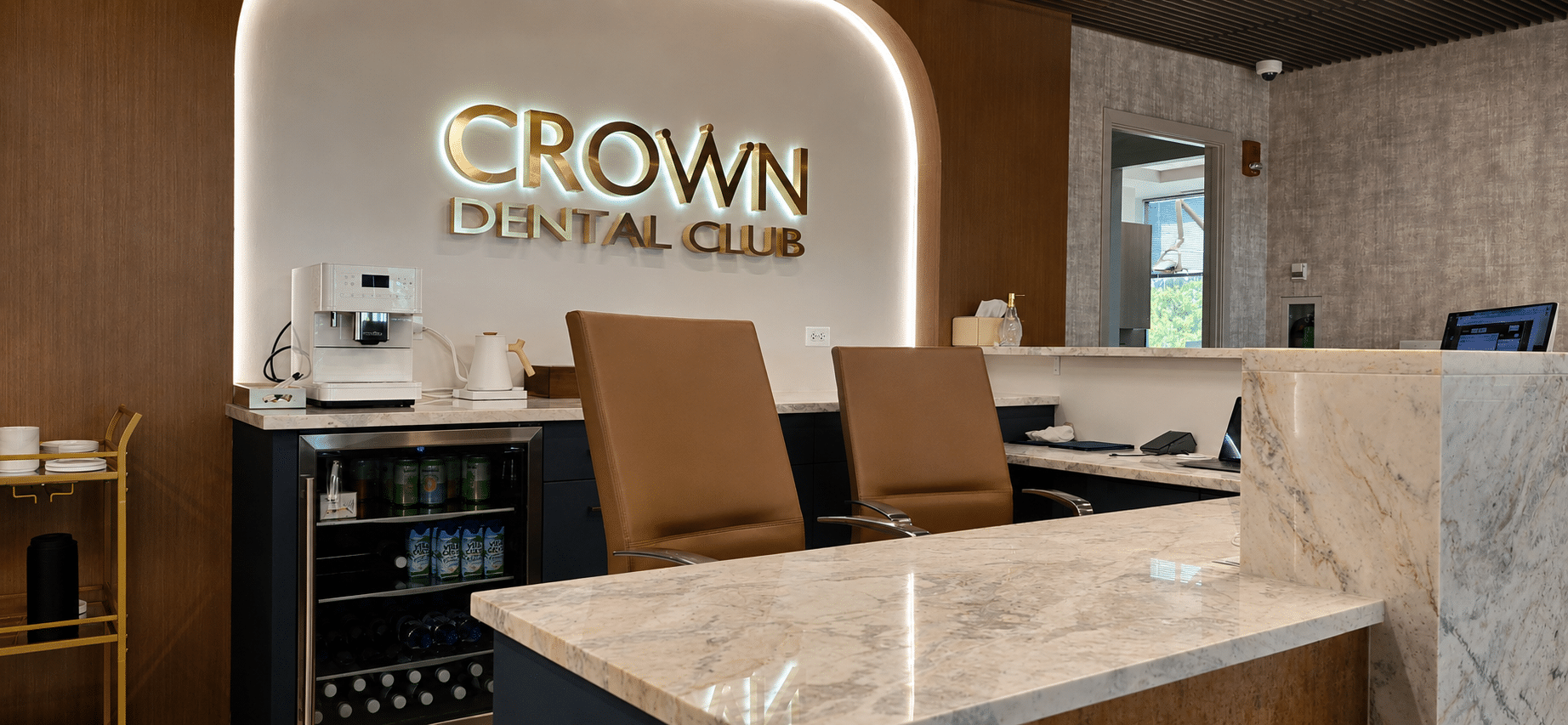
For Crown Dental Club in Skokie, the design called for Matarazzo Dolomite, pronounced curves, and ridged stonework. A standard miter could not follow that geometry. We tested the idea before cutting the final pieces, then completed hours of hand finishing. That preparation turned a difficult concept into a one-day installation.
A Reception Desk Designed to Set the Tone
Crown Dental Club built its Skokie practice around a calmer, more personal approach to dental care. Their reception desk needed to belong in that experience from the moment a patient entered.
The design called for a substantial stone surface with curves and vertical ridges. It also required the top to meet the face of the desk cleanly as the form changed direction.
Matarazzo Dolomite gave the desk its visual movement. That same movement made the fabrication less forgiving.
Every strip and transition would remain visible across the finished surface, so the structure behind the curve had to be planned with care.
For a commercial space, appearance was only part of the assignment. The finished desk also had to arrive on site ready for an efficient installation, with as much uncertainty as possible removed in the shop.
Why the Curves Required a Prototype
A conventional miter joins two straight stone planes at an angle. Crown Dental Club’s desk asked that connection to continue around a curve. Stone cannot simply bend to follow the form.
Before cutting the final pieces, we built a prototype. This allowed us to test the angles, study how the strips met, and see where the transition needed more handwork.
The prototype answered four practical questions:
- Strip width: Two-inch sections gave us enough control to build the curved face
- Back cuts: Each strip needed a narrower back so the wider face could follow the radius
- Piece alignment: The sections had to connect without losing the shape of the curve
- Finish quality: The assembled surface needed to read as one deliberate feature
This is how a curved stone reception desk is fabricated: the shape is broken into workable sections, tested at full scale, cut to fit the radius, and refined by hand before installation.
The prototype made the final work predictable.
Eight Shop Hours Per Curve, One Day on Site
Once the method was proven, we cut the Matarazzo Dolomite into two-inch strips. The back of each piece was angled and hand shaved so the front edges could follow the curve.
Then came assembly and finishing. The pieces had to be glued in sequence while we watched the radius take shape. Each curve required about eight hours of shop work.
That time mattered because the smallest change could affect the next piece.
Rushing one connection would only move the issue farther around the desk.
The work followed a controlled order:
- Shape: Prepare each strip for its exact position on the curve
- Fit: Test how the adjoining pieces meet before final assembly
- Refine: Hand-finish the angles and visible transitions
- Confirm: Review the completed sections before they leave the shop
Several days of in-house fabrication led to a one-day installation. Most of the difficult decisions had already been settled and the parts finished before our crew reached Crown Dental Club.
That is the value of serious preparation. The client sees an efficient day on site because the hard work happened earlier.
Bring the Complex Details to the Table Early
Custom stonework becomes easier to control when the fabricator sees the difficult details before production begins. Curves, unusual transitions, and ridged surfaces affect how the material must be divided and supported.
If you are planning a reception desk or another custom feature, bring the drawings and inspiration to the conversation early. Our commercial stone team can review what the design requires and how it may be fabricated.
Discuss your custom stone feature with Precision Stone Design.
Frequently Asked Questions
What Stone Was Used for Crown Dental Club’s Reception Desk?
The reception desk was fabricated from Matarazzo Dolomite. The material continues across the top and curved vertical face, making the stone part of the desk’s structure and visual identity.
You can view Matarazzo in Precision Stone Design’s collection. Natural slabs vary, so the exact movement and tone should always be reviewed in person before a project moves into layout and fabrication.
How Did Precision Stone Design Create the Curved Sections?
We first built a prototype to test the angles and radius. The final stone was then cut into two-inch strips.
Each strip was narrower at the back than at the face. That geometry allowed the pieces to follow the curve when assembled. The backs were hand shaved as needed, and the sections were fitted in sequence until the full shape came together.
How Long Did the Installation Take?
The on-site installation was completed in one day. That short installation window followed several days of work in the fabrication shop.
Each curve alone required about eight shop hours. By resolving the angles, fit, and finish before delivery, our team reduced the number of decisions that had to be made inside the dental office.
Can Natural Stone Be Used for a Curved Commercial Reception Desk?
Yes, natural stone can be used for a curved reception desk when the design, material, support, and fabrication method are reviewed together.
The exact approach depends on the radius and the way horizontal and vertical pieces connect. Stone type, visible joints, edge conditions, and access to the installation area also matter. Early review gives the fabricator time to test the difficult parts before cutting the final material.